Payout Structures and Their Impact on Strategy in Blackjack Tournaments
Erik Albrecht · Nov 7, 2026
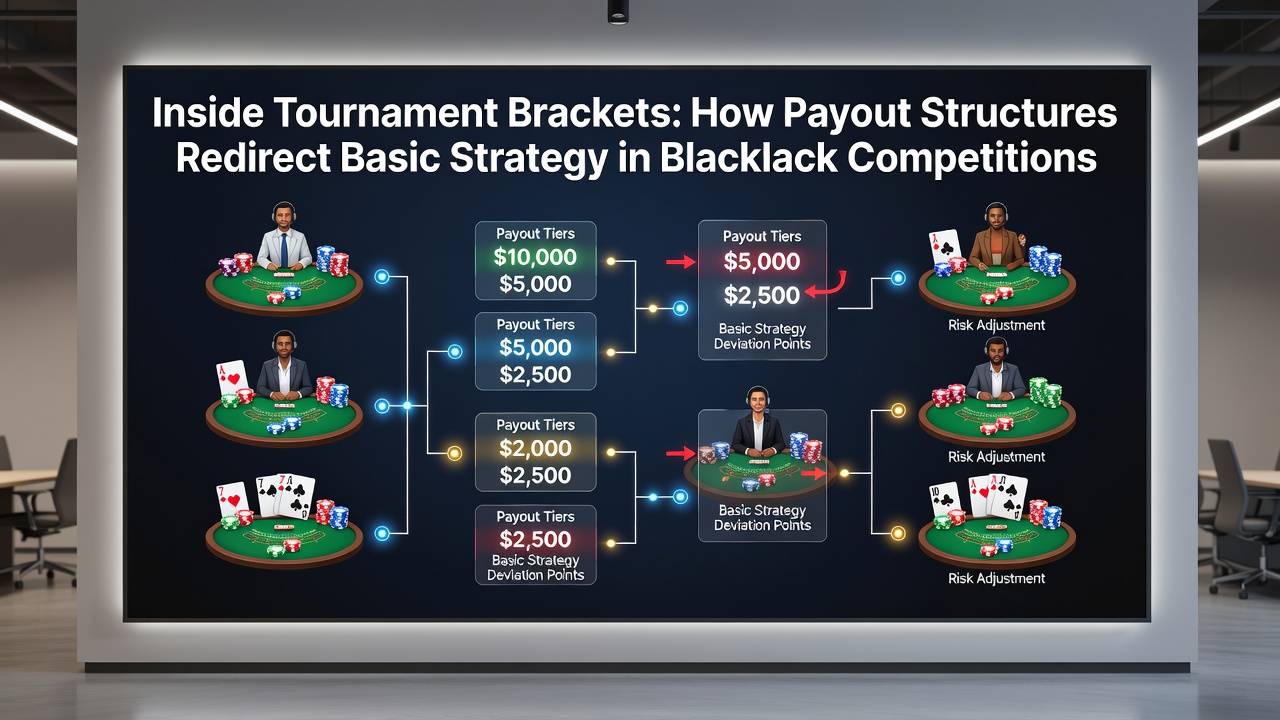
Payout Structures and Their Impact on Strategy in Blackjack Tournaments
Blackjack tournaments operate under rules that differ sharply from standard cash game play, and payout structures stand at the center of those differences because they tie advancement and prize money to relative chip positions rather than absolute expected value on each hand. Observers note that players who follow cash-game basic strategy without adjustment often find themselves eliminated early when brackets reward survival over aggressive maximization of every edge.
Bracket Formats and Chip Accumulation Rules
Most events divide entrants into brackets where the top percentage of chip stacks advance after each round, and this setup forces participants to track not only their own totals but also those of competitors seated at the same table. Data from the Nevada Gaming Control Board shows that average tournament fields in 2025 exceeded 300 players per event, with advancement thresholds typically set at the top 30 to 40 percent after initial rounds. Those thresholds shift depending on the number of tables in play and the speed of play, which creates situations where a modest gain can secure a seat while a larger expected-value play risks elimination if variance turns against the participant.
Round structures also include fixed time limits or hand counts that compress decision windows and prevent slow, methodical bankroll management. Research from the University of Nevada, Las Vegas gaming studies program indicates that time pressure increases the frequency of decisions made under incomplete information about opposing stacks, prompting adjustments that standard basic strategy charts do not address.
Payout Tiers Redirect Risk Calculations
Payout tables in these competitions usually award the largest shares to the final table and top three finishers, while early-round payouts remain modest or nonexistent. This distribution means that preserving enough chips to reach later stages carries higher weight than maximizing return on any single hand, so participants often deviate from basic strategy when facing marginal spots such as doubling down with 10 against a dealer 9 or splitting certain pairs. Studies published in the Journal of Gambling Studies document measurable increases in conservative play when payout jumps occur between fourth and third place or between final table qualification and earlier elimination.
Chip leaders at the start of a round sometimes adopt tighter ranges to protect their position, whereas short stacks pursue higher-variance lines to double up before the round ends. These shifts appear consistently across events tracked by the Australian Communications and Media Authority gaming reports, which record regional tournament data from multiple operators and show that stack-size relative to average influences deviation rates more than card-counting opportunities alone.

Position and Opponent Stack Awareness
Seating order relative to the dealer button and the distribution of chips around the table further modify optimal actions. A player holding a middle stack may choose to stand on a soft 18 against a dealer 10 when the table average sits close to their own total, because busting hands could drop them below advancement lines even if the play carries positive expected value in isolation. Data collected across North American casino events reveals that such position-aware adjustments occur at roughly twice the rate observed in cash games of similar rulesets.
November 2026 schedules already list several multi-day events in Las Vegas and Atlantic City where organizers publish detailed payout ladders in advance, allowing participants to calculate exact advancement targets before play begins. Those published ladders reduce uncertainty about required stack sizes and encourage pre-round planning that incorporates bracket-specific thresholds rather than pure basic strategy frequencies.
Examples from Recent Events
One documented case from a 2025 regional championship showed a player electing to surrender 15 against a dealer 10 late in the round while holding a below-average stack, an action that preserved chips for a subsequent double-up opportunity and secured advancement by a narrow margin. Another instance involved a table leader who declined insurance on a dealer ace when multiple short stacks remained in contention, because the insurance wager risked reducing the lead needed for automatic qualification. These choices align with patterns identified in industry reports from the Canadian Gaming Association, which track how payout weighting alters standard strategy matrices across hundreds of recorded hands.
Conclusion
Tournament brackets and their associated payout structures create measurable incentives that redirect decisions away from cash-game basic strategy toward relative-position management. Participants who study bracket advancement thresholds, monitor opposing stacks, and adjust aggression levels accordingly demonstrate higher survival rates through later rounds. The documented patterns from regulatory data and academic tracking confirm that payout design remains the dominant factor reshaping play once entry fees convert into fixed prize pools.