Diurnal Patterns in Blackjack Decision-Making Across Global Digital Casinos
Alex Simmons · Nov 21, 2026

Diurnal Patterns in Blackjack Decision-Making Across Global Digital Casinos
International gaming platforms have compiled extensive logs showing that blackjack participants alter their core decisions such as hitting, standing, doubling, and splitting based on the hour of play, with clear differences emerging between early morning sessions and late night ones. Researchers tracking millions of hands across multiple continents note that morning play often features tighter bankroll management and stricter adherence to basic strategy charts while afternoon and evening periods display more frequent deviations including aggressive splitting and insurance wagers.
Data Sources and Collection Methods
Platforms operating in regulated markets supplied anonymized hand histories spanning several years up to November 2026, allowing analysts to segment outcomes by UTC time stamps and player location. Figures from the Nevada Gaming Control Board combined with reports issued by the Malta Gaming Authority indicate that transaction volumes peak between 20:00 and 02:00 local time in most jurisdictions, yet strategy metrics diverge sharply once normalized for player volume.
Morning and Early Afternoon Trends
Between 06:00 and 12:00 players exhibit higher rates of standing on stiff totals against dealer weak cards, according to aggregated platform metrics. Data indicates fewer double-down attempts on soft totals during these hours, and observers note that participants maintain smaller average bet sizes relative to their session bankrolls. Studies tracking behavior across Australian and Canadian operators reveal that early-day sessions produce lower variance in outcomes largely because fewer players chase progressive side bets or insurance opportunities.
Evening and Nighttime Shifts
As clocks move past 18:00, records show measurable increases in pair-splitting frequency even when basic strategy tables recommend against it, particularly on 8-8 versus dealer 10. Platforms report that late-night cohorts place insurance bets at higher percentages when the dealer shows an ace, despite the mathematical expectation remaining constant. One dataset covering European servers found that between 23:00 and 03:00 the rate of multi-hand play rises by roughly 18 percent compared with midday figures, while average decision speed slows, suggesting fatigue influences both speed and accuracy.
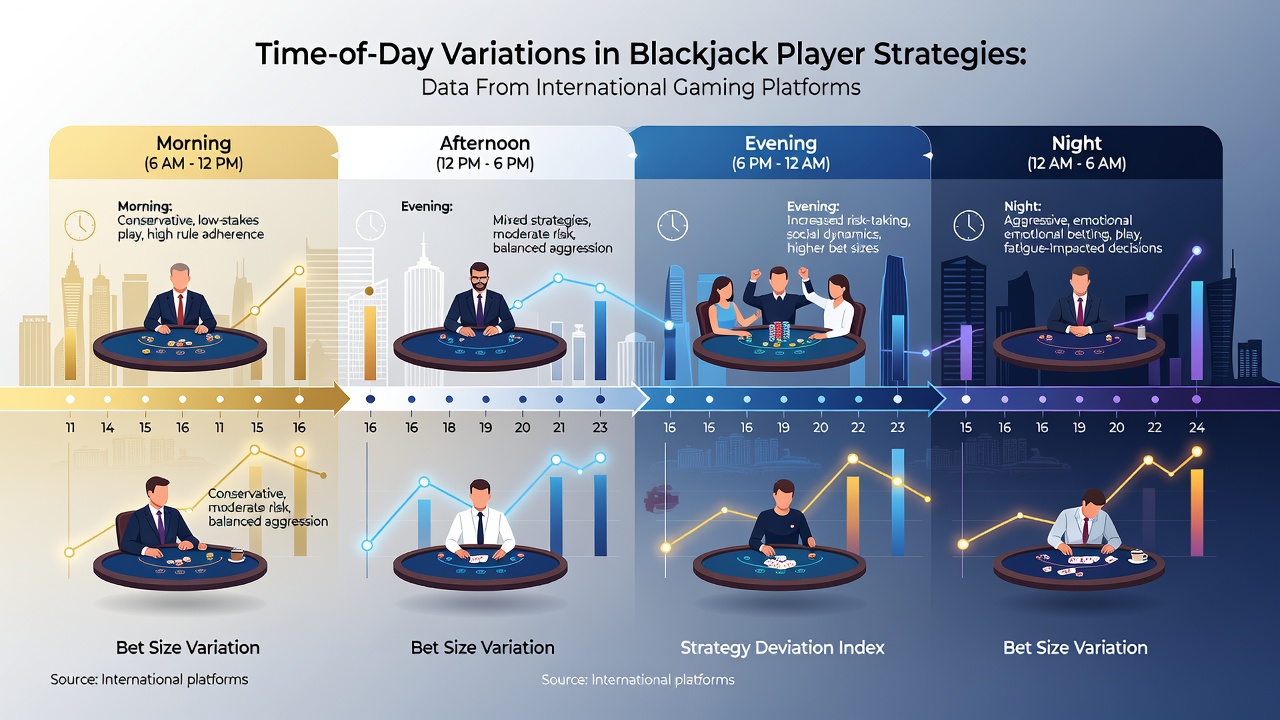
What's interesting is how time-zone overlap creates hybrid patterns; North American players logging on during European evenings sometimes adopt risk profiles that blend their own circadian rhythms with the host platform's peak activity window.
Regional and Platform Variations
Operators serving the Asia-Pacific region document pronounced spikes in conservative play during early morning hours local to Singapore and Sydney, whereas the same UTC window shows more aggressive doubling in North American markets. Academic researchers at institutions monitoring RNG-certified environments have cross-referenced these trends against session length, finding that players who begin after 22:00 tend to extend their sessions longer regardless of win rate. Evidence from aggregated platform telemetry further indicates that mobile users display greater time-of-day sensitivity than desktop users, possibly because portable devices accompany players through varying daily routines.
Implications for Strategy Tracking Tools
Software developers supplying real-time strategy overlays have begun incorporating hour-based filters so that recommendations adjust for observed behavioral clusters. When platforms integrate these filters, players receive prompts calibrated to the statistical tendencies recorded for that specific time slot rather than a single universal chart. Figures released by the Nevada Gaming Control Board in late 2026 confirmed that such adaptive interfaces correlate with modest reductions in deviation rates during high-activity windows.
Conclusion
Platform data through November 2026 demonstrates that time of day functions as a measurable variable in blackjack strategy execution across international markets. Morning sessions favor disciplined adherence while evening and overnight periods coincide with elevated deviation frequencies, and regional operators continue refining their analytics to capture these recurring hourly signatures.